
Sump Pump Weep Hole: Check the Model Before Drilling

Quick answer: A sump pump weep hole decision starts with the exact pump model, valve part number and applicable manual. Record those details before authorizing a change. A photograph or generic drill-size recommendation cannot establish compatibility for your installation.
Editorial method: Prepared with AI assistance from manufacturer guidance. The worksheet and hypothetical examples are original research and planning aids, not equipment test reports.
Last reviewed: .
A sump pump weep hole can release trapped air, but drilling one is not the right next step for every pump. The answer depends on the exact pump, its instructions and the installed discharge components. Before changing anything, identify those parts and find the applicable manual.
The useful question is more specific than “What size hole should I drill?” Ask: “What air-relief arrangement does the manufacturer specify for this pump and this installation?” That question also helps when a small opening sprays water, a replacement pump looks different from the old one, or two online guides disagree.
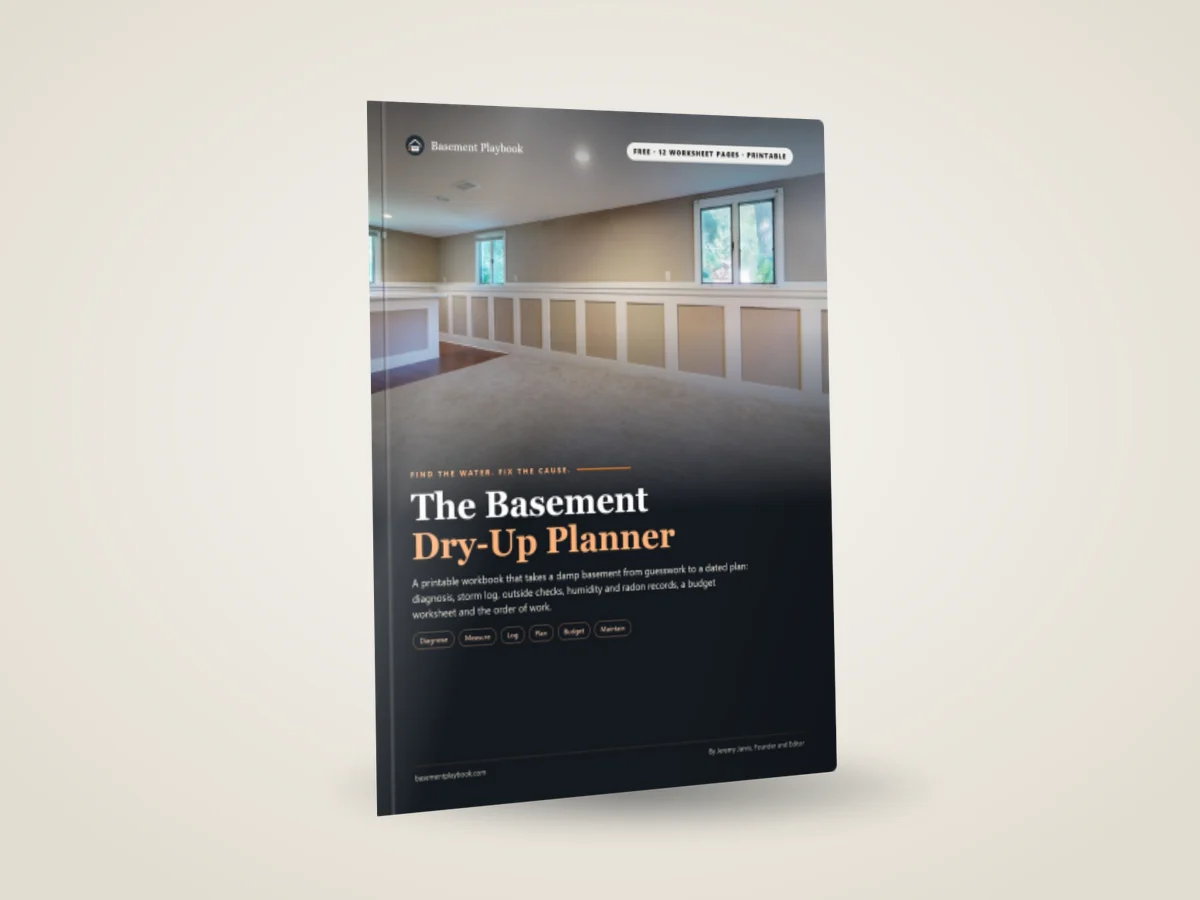
Free download: The Basement Dry-Up Planner
Our 12-page printable planner: your basement today, measure and map, which kind of water you have, a storm log, outside checks, pump and humidity records, radon and crack logs, a budget worksheet and the order of work.
This guide is a research-based planning aid. It is not a hands-on equipment test. Instead, this guide helps you prepare a clear record for the manufacturer or a qualified installer. However, it does not provide a universal drilling template or diagnose a pump from its sound.
What a sump pump weep hole does
Boshart describes an air-release opening as a way for trapped air to leave a pump housing so the pump can prime. Its guidance also warns that some pump designs already provide air-lock protection and that an external opening is not appropriate for every installation. Follow the pump manufacturer's requirements, not a rule borrowed from a different unit. Boshart support
This distinction matters when you inspect an unfamiliar system. A feature in the pump, an opening in the discharge pipe and a vented check valve are different components. Finding one does not tell you, by itself, whether the complete arrangement matches the instructions.
First, start with identification rather than modification. If the label cannot be read safely, record that it is unknown and arrange service. A guess based on housing color or a similar product photograph is not enough to select an installation procedure.
For an overview of the surrounding equipment, see our sump pump guide. Keep this article focused on air relief; pump sizing, backup runtime and general maintenance are separate decisions.
Why a single sump pump weep hole size is misleading
The following are examples of different manufacturer guidance, not interchangeable specifications. The source column is part of the answer: a dimension without its model scope is incomplete advice. For example, the linked Liberty manual identifies its covered families as the 230, 240 and 450 series.
| Example checked | What the source establishes | What still needs checking at your home |
|---|---|---|
| Liberty 230, 240 and 450 series; manual 7108000L | The manual describes an integral anti-airlock opening and recommends an additional discharge-pipe opening no larger than 1/8 inch to assist air bleeding. Its location is specified in the manual. | Exact model coverage, installed components and the applicable instructions for the particular system. |
| WAYNE CDU980E product page | WAYNE says this model's top-suction design does not need a weep hole. | Confirm the nameplate and applicable manual; do not extend this statement to another WAYNE model. |
| Boshart BSC check-valve variants | Boshart distinguishes versions with a molded air-release opening from non-vented versions and says to follow the pump manufacturer's requirements. | The full valve part number and whether that variant belongs in the pump's specified installation. |
Sources: Liberty manual 7108000L, pages 1, 4–5; WAYNE CDU980E; Boshart support.
These examples explain why a sump pump weep hole guide should not tell everyone to use the same drill bit. They also do not establish that one pump is better than another. Instead, the comparison concerns instructions for existing equipment, not performance testing or a buying recommendation.
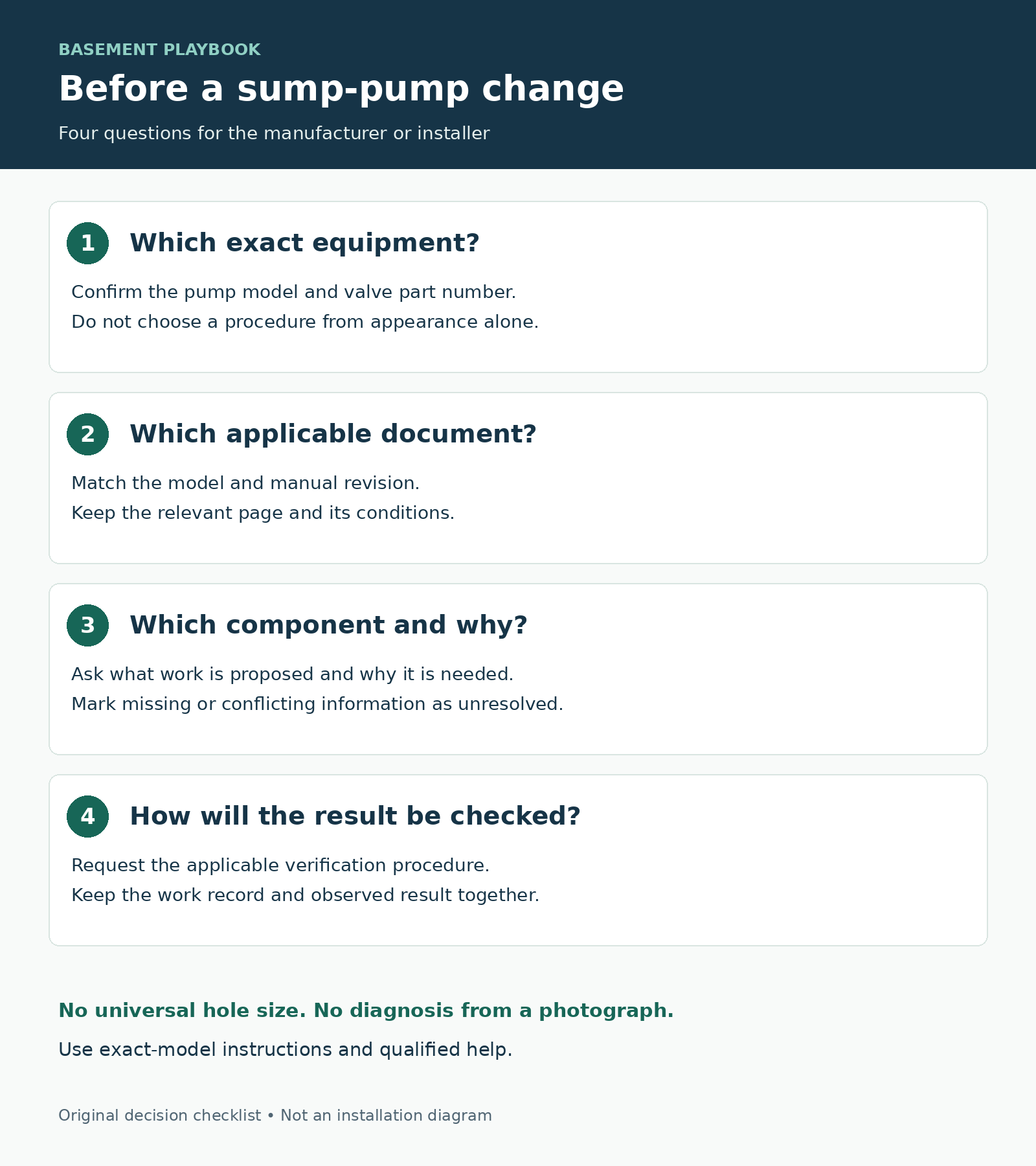
If an installer proposes a change, ask them to identify the instruction that applies to your model and the component they intend to change. That creates a reviewable answer: model, document, page, proposed work and final verification. “That is how we always do it” leaves too much unspecified.
Build a component record before authorizing work
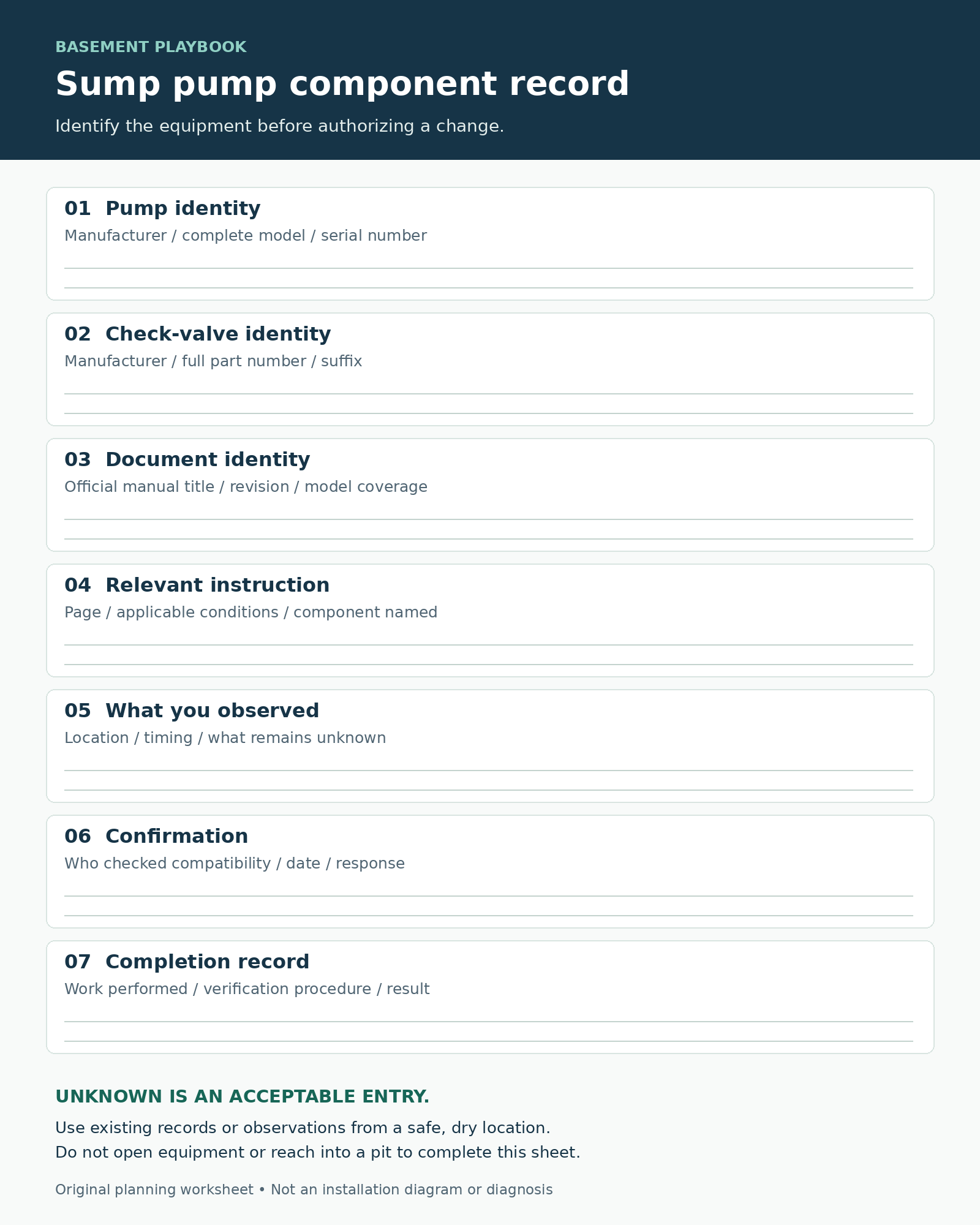
Use the worksheet below from a safe, dry location. It is fine to leave a field unknown. Do not open equipment, remove a sealed cover or reach into a pit just to complete paperwork.
Liberty's manual requires disconnection before handling or adjustments and assigns installation and maintenance to qualified personnel. Treat its safety instructions as part of the procedure, not an optional page before the useful information. Liberty manual, page 2
| Record | Your entry | Evidence to keep |
|---|---|---|
| Pump manufacturer and complete model | __________________ | Existing label photograph, purchase record or installer confirmation |
| Serial number or manufacturing information | __________________ | Record exactly; mark illegible characters as unknown |
| Primary or backup pump | __________________ | Identify which unit the question concerns |
| Check-valve manufacturer and full part number | __________________ | Include any suffix; do not substitute the series name |
| Manual title and revision | __________________ | Save the official document and the date you checked it |
| Model listed in that manual | Yes / No / Unknown | Cover or model table reference |
| Relevant instruction and page | __________________ | Note the instruction's conditions, not just a dimension |
| Existing opening, if visible safely | Pump / Pipe / Valve / Unknown | A description of what you actually observed |
| Who confirmed compatibility | __________________ | Manufacturer response or written installer explanation |
| Work and verification record | __________________ | Date, technician and applicable test procedure |
Keep observations separate from conclusions. For example, “small opening visible in the valve body” is an observation. However, “the system is installed correctly” is a conclusion that requires more evidence. Similarly, “I cannot see an opening” does not prove one is absent.
For example, a record is especially useful after a pump replacement. The old invoice may describe a previous pump while a newer receipt describes the current one. Put the dates beside both records so the installer can tell which information applies. Do not discard an unresolved mismatch by choosing whichever document gives the simplest answer.
Resolve conflicting sump pump weep hole advice
When two instructions appear to disagree, stop before comparing their drill sizes. Check whether they describe the same model, the same component and the same installation conditions.
First, distinguish a product page from an installation manual. A product page can establish a named feature, as in the WAYNE example above. It is not a substitute for the complete installation procedure. An article covering several models has an even broader scope.
Second, check whether the manual actually lists your model. A search result can lead to a similar product or an older file. Use the manufacturer's resource center and preserve the document title and revision. For Liberty, the official resource center provides a route to its installation documents.
Third, identify exactly what is being discussed. A recommendation concerning a discharge-pipe opening is not automatically permission to modify a pump housing or a valve. Ask for clarification if the proposed work names a different component from the cited instruction.
Finally, send the unresolved facts to the manufacturer or installer. A useful question includes the pump model, valve part number, document revision and the two instructions that appear inconsistent. Ask which applies to the installed combination. Save the response with the service record.
This process may end with “no change needed,” a specified repair, or a request for an inspection. Each can be a useful result. Therefore, the goal is an equipment-specific answer, not finding a reason to drill.
A sump pump weep hole spraying water needs context
Liberty's manual says a small spray from the covered pumps' air-bleed opening can be normal during operation. That statement does not identify the source of every spray near a sump pump. Liberty manual, pages 4 and 6
Record where the water appears to come from and when it happens, if you can observe without approaching exposed electrical equipment or entering water. Use “opening in pipe,” “joint,” “valve body” or “source unclear” rather than calling all of them weep holes.
Do not plug an unidentified opening to stop the visible spray. Obtain a diagnosis and the applicable instructions first. Likewise, water escaping onto the floor should not be dismissed because an online guide says that some spraying is normal.
For a sump pump weep hole service request, separate three questions:
- Is this an intended opening for the installed equipment?
- Does the installed arrangement match the applicable instructions?
- What checks are needed to establish that the system operates correctly?
Those questions are more useful than asking whether “a little spray is okay” without identifying its source. A short description with the component record gives the person helping you a much clearer starting point.
Three examples of better service notes
These are hypothetical paperwork examples, not accounts of repairs or measured results.
A replacement pump with old paperwork. A homeowner has a recent pump invoice and a manual left by a previous owner. The two show different model numbers. The helpful note is: “Current invoice says model A; stored manual covers model B. Please confirm the installed model and provide its applicable instructions.” The records establish a mismatch, not a defect.
A valve whose version is unclear. The visible valve carries a series name, but its full part number is unreadable. A shopping page shows both vented and non-vented variants. The helpful note is: “Please identify the installed valve variant and confirm its compatibility before recommending a replacement.” The existence of multiple variants does not establish which is present.
Water appears during operation. Someone notices water near a fitting but cannot tell whether it comes from an intended opening or a joint. The helpful note is: “Water appears near this fitting when the pump runs; source unknown. Please inspect and document the cause.” Avoid converting an observation into “the weep hole leaks” before the opening has been identified.
In each example, the improvement is the same: the note states what is known, what is unknown and what decision is needed. That makes it easier to review a proposed remedy without pretending the homeowner has already diagnosed the system.
Copy this manufacturer or installer handoff
I need help confirming the air-relief arrangement for my sump pump. The pump model is ______ and the check-valve part number is ______. The available manual is ______, revision ______, page ______. My observation is ______. I have not confirmed the cause. Please tell me whether these instructions apply to the installed combination, what work is needed, and which procedure will verify the result.
Add relevant history: a recent replacement, the date the symptom first appeared, and who last serviced the equipment. Keep speculation in a separate note, clearly labeled. If a field is unknown, write “unknown” rather than filling it from a visually similar product listing.
For a quotation, request the proposed part number, the reason for replacement, and the verification included in the service. Keep the invoice and the final explanation together. This guide provides no price estimate because the work cannot be scoped from a keyword or a photograph alone.
What to keep after the work is complete
Keep a record that another person can use
Create one folder for the installed system. Use descriptive filenames such as “pump-model-label,” “valve-part-number,” “manual-revision,” and “service-date.” Put replaced equipment in a clearly marked old-equipment folder. This is an organization method, not a maintenance requirement.
Next, add a one-page index identifying which document belongs to which component. If the primary and backup pumps have separate instructions, give them separate entries. A folder full of manuals is less helpful when nobody knows which equipment each file describes.
Include the installer's answer in the index. Note whether it confirms identification, explains a proposed change, or records a completed check. Those are different kinds of evidence. Finally, leave a clear unresolved-items line. An unanswered compatibility question should remain visible when the records pass to another household member or a future service company.
Ask for a record of the installed parts and the applicable instructions used. If a part changed, update the component worksheet so the next service visit does not start from outdated information.
The completion note should distinguish work performed from testing performed. “Valve replaced” describes an action. A separate description of the verification procedure and its observed result explains how the work was checked. Neither a quiet motor nor a neat-looking installation is a substitute for that record.
For the broader seasonal routine, use our sump pump maintenance guide alongside the equipment manufacturer's requirements. If a quote expands into a larger replacement project, our sump pump installation cost guide explains the different job scopes. Those links address the surrounding decisions without turning this article into another general pump guide.
Frequently asked questions
Does every sump pump need a weep hole?
No. The WAYNE CDU980E product page specifically says its design does not need one, while other equipment has different instructions. Identify the exact model and applicable installation document before deciding.
Can I copy the hole size from a different pump?
Do not transfer a dimension between models. The Liberty manual example above limits its recommended opening to 1/8 inch. That is a scoped instruction, not a universal specification.
Does a hole in the check valve settle the question?
No. Boshart supplies different valve variants and directs users to the pump manufacturer's requirements. The installed combination still needs to be identified and checked.
What if the model label cannot be read safely?
Leave the model unknown in the worksheet. Check existing invoices or ask the installer to identify it. Do not infer a model from appearance alone or take risks to obtain a photograph.
What is the most useful thing to send with a service request?
Send the pump model, valve part number, manual revision, a plain description of the observation, and the specific decision you need help with. Mark missing information clearly.
Sources and method
Manufacturer sources checked November 17, 2026: Liberty installation manual 7108000L, the WAYNE CDU980E product page, and Boshart's explanation of BSC air-release variants. The worksheet and hypothetical service notes are original editorial tools. We have not tested these products, inspected your installation or verified compatibility for an individual home.
By Jeremy Jarvis, publisher of Basement Playbook. This article is a research-based planning guide, not a report of hands-on equipment testing.
Keep planning
- Sump Pump Float Switch: Types and Safe Checks
- Basement Water Alarm: Where to Put One and Which Type
- Yard Drainage: Fix the Water Before It Reaches the Basement
- Sump Pump Maintenance: A Twice-Yearly Routine
Go deeper: Wet Basements & Drainage hub · Sump Pump Sizing Calculator · French Drain Material Calculator

Written by Jeremy Jarvis
Jeremy Jarvis is the founder and editor of Basement Playbook, where he builds research-based guides and free planning tools for wet basements and crawl spaces: sump pumps and drainage, encapsulation, dehumidification, radon testing and mitigation, foundation cracks and finishing a basement that stays dry. He sets the site's editorial standards, checks every guide against official sources such as EPA radon and mold guidance, CDC, ENERGY STAR, state health departments and manufacturer documentation, and is responsible for corrections. Structural and radon mitigation work is always referred to a licensed engineer or a certified mitigator. Jeremy also founded Eco Nomad Travel, Mind Clarity Hub, SilkHarborTravel, WanderOza Travel, Freedom Road Living, PowerProof Home and Garage Playbook, and he is the author of books on clarity, focus and practical AI, including The Power of Clarity and Digital Clarity.
Questions and comments