
French Drain Cost: Price Per Foot, Interior vs Exterior
French drain cost is quoted across a span so wide that the averages are almost useless on their own. Published figures run from $500 to $18,000 for the same named product. That is not inconsistency; it reflects the fact that one job is a trench in a lawn and the other is a channel cut around the inside of a basement slab. This guide separates the two and gives you the numbers that actually travel, so you can judge a french drain installation cost against the right benchmark rather than a national average.
Last reviewed and updated: October 9, 2026. Written by Jeremy Jarvis.
Key takeaways
- Fixr puts the national average at $5,000, with a typical range of $2,800 to $6,500 and a full span of $500 to $18,000.
- Bob Vila cites $10 to $50 per linear foot outside, against $40 to $100 per linear foot for a basement drain.
- The gap is concrete: a basement run means breaking out the slab and excavating beneath it.
- Fixr notes most homeowners installing one in a basement spend around $5,000 for 100 linear feet.
- Length, depth and access drive the price far more than the pipe itself, which is the cheapest part.
Price your own run
Work out the stone, pipe and fabric your run needs with the French Drain Material Calculator, then apply the per-foot bands below to the same length.
French drain cost: the headline numbers
Two sources agree closely on the overall shape of french drain cost.
Fixr, updated January 2025, gives a national average of $5,000. Its typical range is $2,800 to $6,500. The floor is $500 for a 50 linear foot drain in an exterior location. The ceiling is $18,000 for an extensive 100 linear foot perimeter drain to stop basement flooding. Fixr also notes that most homeowners installing one in their basement spend around $5,000 for 100 linear feet.
Bob Vila, citing Angi and HomeAdvisor, gives the identical $500 to $18,000 span with a $5,000 national average. In short, the two independent sources land in the same place.
So the averages agree. However, an average drawn from a 36-fold range tells you almost nothing about your own house. Therefore the per-foot figures below matter far more than the headline.
Price per linear foot is the number that travels
Here the two jobs separate. For checking a quote, french drain cost per linear foot is the single most useful figure you have.
| Location | Cost per linear foot | Source |
|---|---|---|
| Exterior, open ground | $10 to $50 | Bob Vila |
| Interior, under a basement slab | $40 to $100 | Bob Vila |
At the midpoints that is roughly $30 outside against $70 inside, so a basement run costs a little over double. At the extremes, meanwhile, the gap widens to tenfold. In practice, measure the run you need, multiply by both ends of the relevant band, and you have the range a reasonable quote should sit inside.
Why the interior job costs so much more
Bob Vila states the reason plainly: basement french drain costs are often higher due to the need to break out concrete in a basement floor to excavate beneath and install the drain.
Unpack that sentence and the french drain cost gap makes sense.
- The slab has to be saw-cut around the full perimeter, which is slow, dusty work.
- The broken concrete and excavated soil leave the building by hand or by bucket, not by machine.
- The trench runs next to a footing, so the depth is constrained and the work is careful.
- Pipe and stone go in, then the slab is re-poured and finished.
- All of it happens inside an occupied house, with dust containment and no room for a machine.
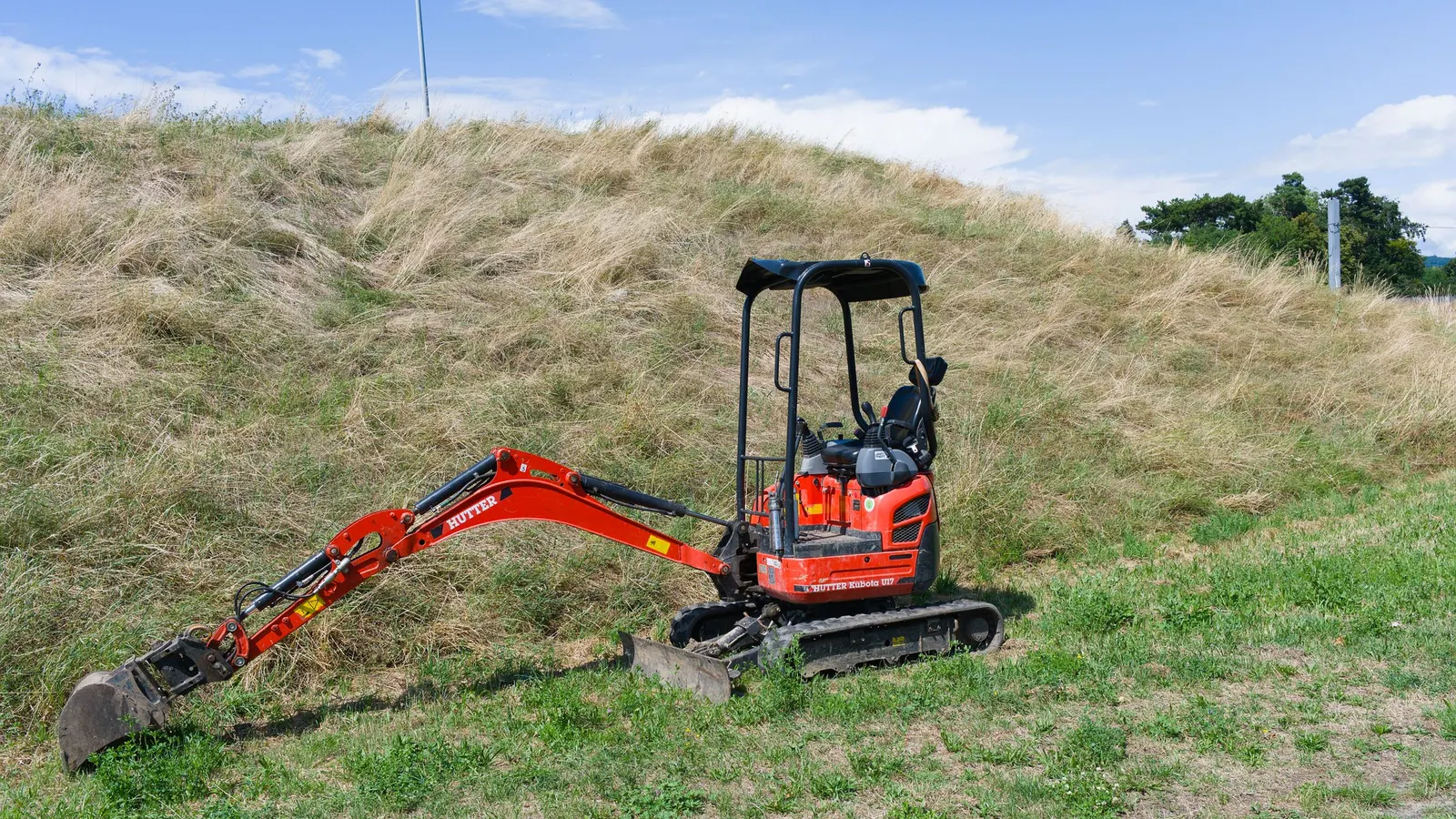
Outside, by contrast, the same pipe goes into a trench a mini-excavator opens in an afternoon. The material cost is nearly identical; the labor is not. Consequently the quoted difference is almost entirely a difference in hours.
What a french drain price actually includes
A complete installation normally includes excavation, filter fabric, washed stone, perforated pipe, backfill, a discharge arrangement and the removal of spoil. Our french drain guide covers how the system works.
| Component | Share of a typical job | Notes |
|---|---|---|
| Labor and excavation | Largest | Dominates both versions; the whole reason interior costs more |
| Stone and fabric | Moderate | Bulk material, priced by volume and haulage |
| Perforated pipe | Small | The cheapest part of a drainage system |
| Spoil removal | Moderate | Much higher indoors, where it is carried out by hand |
| Concrete reinstatement | Interior only | Saw cutting plus re-pour and finish |
| Sump pit and pump | Optional | Needed wherever gravity discharge is impossible |
| Restoration | Varies | Lawn, planting, paths or patios disturbed by an exterior run |
What moves the number up or down
Fixr lists size, length, depth and location as the main drivers, and notes that prices vary based on drain length, depth and installation location.
Length. This is a direct multiplier. Typically a single wet wall is a fraction of a full perimeter, so partial runs are genuinely cheaper rather than just cheaper-looking.
Depth. Deeper trenches mean more spoil, more time and sometimes shoring. A drain at footing depth costs more per foot than a shallow surface interceptor.
Access. A machine that can reach the trench line changes the labor completely. Conversely, narrow side returns, fences, mature trees and tight urban lots all force hand digging. For that reason two identical houses on different lots can quote very differently.
What is in the way. Driveways, patios, decks, steps and irrigation all add removal and reinstatement.
Discharge. A gravity outfall downhill is nearly free. A sump, a pump and a circuit are not.
Soil. Heavy clay and rocky ground slow digging down. Sandy soil, on the other hand, speeds it up considerably.
Three worked french drain cost examples
These examples use the published per-foot bands. They are arithmetic, not quotes. Still, they show how french drain cost scales with length rather than with the house.
One wet exterior wall, 40 linear feet. At $10 to $50 per linear foot that is $400 to $2,000. Naturally this is the job that sits near Fixr’s $500 low end. Above all, it is the one most worth trying before anything larger.
Full interior perimeter of a 30 by 40 foot basement, 140 linear feet. At $40 to $100 per linear foot that is $5,600 to $14,000, plus a sump and pump if gravity discharge is impossible. That lands squarely between Fixr’s $5,000 basement figure and its $18,000 ceiling.
Two interior walls only, 70 linear feet. At the same rates, that is $2,800 to $7,000. In practice, partial runs are common where the water consistently appears on one side of the house. Meanwhile the remaining walls can always be added later if the evidence changes.
Why two french drain cost quotes for one house diverge
When two estimates differ by a factor of two, the cause is almost always scope rather than greed. Therefore check each of these items before you compare prices.
- Full perimeter against two walls, which can halve the length.
- Interior against exterior, the single biggest price difference.
- A sump pit, a pump and an electrical circuit included, or quietly left out.
- Concrete reinstatement in the price, or listed later as an extra.
- Spoil removal and skip hire included, or billed on completion.
- Landscaping restoration on an exterior job, or left to you.
- The discharge point, and whether a long run to daylight has been priced.
Line those seven items up across three quotes. Frequently the cheap one then turns out to be a smaller job rather than a better deal. Of course that can still be the right choice, provided the smaller job addresses the wall the water is actually coming through.
Permits, discharge rules and the hidden line item
Drainage work is regulated more often than homeowners expect, and the rules sit on the discharge end rather than the trench.
In many jurisdictions you may not discharge collected groundwater into the sanitary sewer, and in some you may not run it onto a neighboring property either. As a result, a contractor sometimes has to price a much longer run to reach a lawful outfall, a dry well, or a storm connection. That single constraint can move a quote by more than a thousand dollars.
In addition, before any digging starts the utility locate service must mark buried services. This is free in most of the United States and it is not optional; striking a gas or fiber line turns a drainage job into a very different kind of bill.
Finally, ask whether a permit is required. Where it is, the fee itself is usually modest, but the inspection schedule can add days to the job.
What it costs to keep working
A french drain is not maintenance-free. However, the running costs stay small compared with the original french drain cost.
The pipe can silt up over time, particularly where filter fabric was omitted or the stone was not washed. Jetting a clogged run costs a few hundred dollars and is far cheaper than replacing it. Similarly, an exterior outfall needs its grille kept clear of leaves, which is a five minute job twice a year.
Where the drain ends in a sump, the pump is the one part with a limited service life. Budget for replacement rather than being surprised by it, and size it properly in the first place; our sump pump guide covers that choice.
Above all, keep a note of where the pipe runs and where it discharges. A future owner, or a future you, will otherwise be guessing.
Legitimate ways to spend less
Do the free work first. Gutters, downspout extensions and regrading all reduce the water arriving at the wall. Occasionally they remove the need for a drain altogether, which is the largest saving available. Our waterproofing guide sets out that order.
Next, drain only the wet side if the evidence points one way. Similarly, use gravity discharge wherever the ground allows it, because a pump adds both a purchase and a running cost. Where possible, combine the work with other excavation you were already planning. Finally, get quotes outside the spring rush, when drainage contractors are busiest and least inclined to sharpen a price.
What does not save money, by contrast: choosing the cheapest quote without comparing scope, or buying a shallow drain where a footing-depth one was needed. In both cases the job gets done twice.
Doing it yourself
An exterior drain in open ground is genuine DIY for a fit person with a rented trencher. Materials for a 40 foot run are a few hundred dollars. As a result, the saving is most of the labor. You still need consistent fall, filter fabric around the stone, the pipe’s perforations oriented correctly, and a lawful discharge point.
An interior perimeter drain is not DIY. Cutting a slab beside a footing is specialist work. So is keeping dust out of the rest of the house, and so is re-pouring a finished floor. Moreover, the consequences of excavating wrongly next to a foundation are structural.
How it compares with the alternatives
A french drain is one line on a longer menu. Seeing french drain cost beside the alternatives makes the choice clearer.
| Measure | Indicative cost | What it addresses |
|---|---|---|
| Downspout extensions | Lowest | Roof water delivered at the wall |
| Regrading the first ten feet | Low | Surface water running toward the house |
| Exterior french drain | $10 to $50 per linear foot | Groundwater intercepted before the wall |
| Interior french drain | $40 to $100 per linear foot | Water already under the slab |
| Full waterproofing package | $3,000 to $10,000 | A combination, priced as one job |
Notice that the two cheapest rows are not drains at all. For that reason they belong first in any sequence of work, not because they always solve the problem, but because they are quick and they shrink whatever comes next.
When a drain is the wrong spend
If the basement is damp rather than wet, with condensation on cold surfaces in summer, a drain will not help. After all, there is no liquid water for it to collect. Instead that is a dehumidification question, at a small fraction of the cost.
If a wall is bowing or cracking, get a structural engineer in before any drainage contractor quotes. Otherwise you may pay for drainage twice, since the trench route often changes once the structural remedy is known.
And if nobody has looked at the gutters, start there. It is the cheapest hour in this whole subject, and it occasionally makes the rest of the quote unnecessary.
Frequently asked questions about french drain cost
How much does a french drain cost?
Fixr, updated January 2025, gives a national average of $5,000 with a typical range of $2,800 to $6,500, and a full span of $500 at the low end for a 50 linear foot exterior drain up to $18,000 for an extensive 100 linear foot perimeter drain to stop basement flooding. Bob Vila, citing Angi and HomeAdvisor, gives the same $500 to $18,000 span and the same $5,000 average.
What is the cost per linear foot?
Bob Vila puts exterior installation at $10 to $50 per linear foot. A basement drain runs an average of $40 to $100 per linear foot, because the work requires breaking out concrete in the basement floor to excavate beneath it. Multiplying your perimeter by those bands is the fastest way to sanity-check a quote.
Why is an interior french drain so much more expensive?
Because of the slab. An exterior trench is dug in soil with a machine; an interior run means cutting concrete, removing the spoil by hand through the house, laying pipe and stone in the channel and then re-pouring concrete over it. The pipe is the same; everything around it is harder.
Is a french drain worth the money?
If water is actively entering the basement and cheaper measures have not fixed it, usually yes. Bob Vila notes that pooling water around a crawl space or basement can lead to structural damage to a foundation, and water in a basement can damage possessions and lead to mold growth. Set the cost against that, not against nothing.
Does a french drain need a sump pump?
Only if the water cannot leave by gravity. Where the ground falls away from the house, the pipe can daylight downhill at no extra running cost. Where it cannot, the drain terminates in a sump pit and a pump lifts the water out, which adds both the pump and an electrical circuit to the job.
Can I install a french drain myself?
An exterior drain in open ground is realistic DIY if you can handle the digging, get the fall right and have somewhere legal to discharge. An interior perimeter drain is not: it involves cutting a structural slab close to a foundation footing, and getting that wrong is expensive in a way the saved labor does not cover.
Sources and how we researched this guide
Research-based. We did not commission a drain for this article. Every figure is attributed to Fixr or Bob Vila with its scope and date, and where the two differ the difference is explained rather than averaged. Local labor rates move these numbers more than any other factor, so treat them as a sanity check on a quote, not a prediction. Found something out of date? Tell us and we will check it against the source.
Keep planning
- Sump Pump Maintenance: A Twice-Yearly Routine
- Sump Pump Installation Cost: What Drives the Price
- Water in Basement After Rain: How to Find the Cause
- Flooded Basement: Safe Steps to Clean Up and Dry Out
Go deeper: Wet Basements & Drainage hub · Sump Pump Sizing Calculator · French Drain Material Calculator

Written by Jeremy Jarvis
Jeremy Jarvis is the founder and editor of Basement Playbook, where he builds research-based guides and free planning tools for wet basements and crawl spaces: sump pumps and drainage, encapsulation, dehumidification, radon testing and mitigation, foundation cracks and finishing a basement that stays dry. He sets the site's editorial standards, checks every guide against official sources such as EPA radon and mold guidance, CDC, ENERGY STAR, state health departments and manufacturer documentation, and is responsible for corrections. Structural and radon mitigation work is always referred to a licensed engineer or a certified mitigator. Jeremy also founded Eco Nomad Travel, Mind Clarity Hub, SilkHarborTravel, WanderOza Travel, Freedom Road Living, PowerProof Home and Garage Playbook, and he is the author of books on clarity, focus and practical AI, including The Power of Clarity and Digital Clarity.